Braille Room Number Signs: Everything You Need to Know
Every building has rooms that people need to find quickly, whether it's a hotel suite, a hospital ward, a classroom, or an office. For people who are blind or have low vision, visual signs alone don't help. That's where braille room number signs come in.
These signs combine raised characters and Grade 2 Braille so visitors can identify a room by touch. In this guide, you'll learn what braille room signs are, what ADA rules apply, how to choose the right materials, and where to install them.
What Are Braille Room Number Signs?
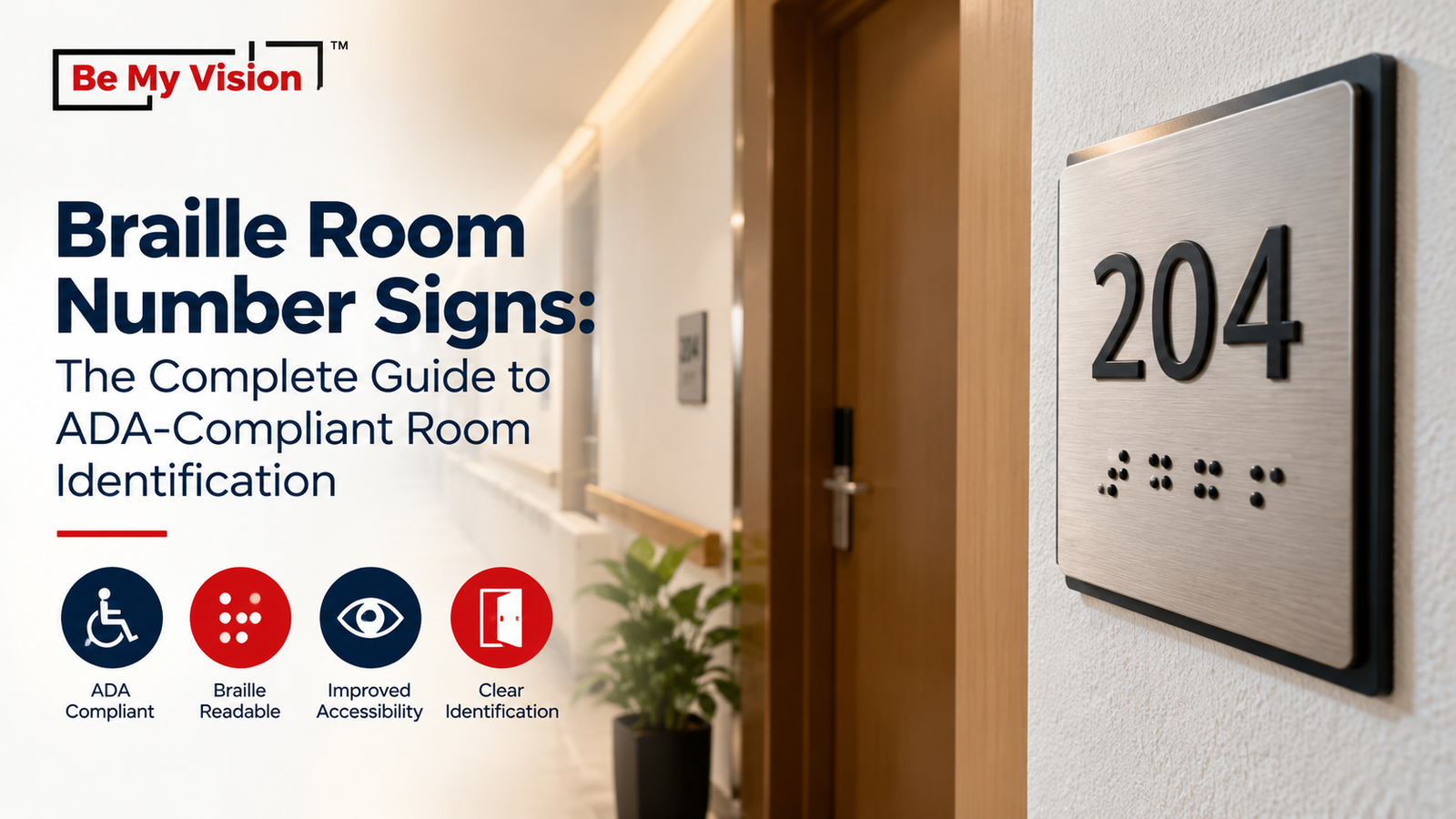
Braille room number signs are permanent identification signs that display a room number or name in three formats at once:
- Visual text for sighted users
- Raised tactile characters that can be read by touch
- Grade 2 Braille (contracted Braille) placed below the text
Because they serve both sighted and visually impaired people, they are often called tactile room signs or braille room identification signs. The terms braille door signs and braille room signs are used interchangeably across the industry.
Why Braille Room Signs Matter
- Accessibility and independence. Tactile signage lets blind and low-vision visitors navigate on their own without asking for help.
- Legal compliance. In the United States, the Americans with Disabilities Act (ADA) requires accessible signage for permanent rooms and spaces. Non-compliant signs can lead to complaints, fines, and costly replacements.
- Safety. Clear room identification helps everyone, especially in emergencies when quick wayfinding matters.
- Professional image. Well-designed braille door signs show that your organization values inclusion and attention to detail.
ADA Requirements for Braille Room Number Signs
If you are buying braille room identification signs for a US facility, make sure they meet these key ADA guidelines (2010 ADA Standards):
|
Requirement |
Specification |
|
Braille type |
Grade 2 (contracted) Braille |
|
Raised character height |
5/8 inch to 2 inches |
|
Raised character depth |
At least 1/32 inch above the background |
|
Font style |
Sans serif, uppercase letters |
|
Finish |
Non-glare (matte) for both characters and background |
|
Contrast |
Characters must contrast strongly with the background |
|
Braille position |
Directly below the corresponding text |
|
Braille dots |
Rounded or domed |
Mounting height: The baseline of the lowest Braille cell should be at least 48 inches above the floor, and the baseline of the highest raised character should be no more than 60 inches above the floor.
Mounting location: Install the sign on the wall at the latch side of the door. If there is no wall space on that side, place it on the nearest adjacent wall. Leave clear floor space so a person can stand close enough to touch the sign without being hit by a door swing.
Note: Always check your local building codes and the latest ADA standards, as requirements can differ by region and project type.
Which Rooms Need Braille Door Signs?
Under ADA guidelines, signs that identify permanent rooms and spaces must be tactile and include Braille. This typically includes:
- Room numbers and names (offices, classrooms, conference rooms)
- Restrooms
- Exits and stairwells
- Hotel and hospital rooms
- Laboratories and storage rooms with permanent functions
Temporary signs, such as those for a short event, usually do not require Braille.
Types of Tactile Room Signs
1. Raised Copy with Applied Braille
Characters are raised, and Braille dots are embedded into the sign. This is the most common and durable option for braille room signs.
2. Photopolymer Signs
A UV-cured resin creates raised letters and Braille directly on the sign face. These are crisp, long-lasting, and widely used in commercial buildings.
3. Engraved Signs
Characters are engraved and then filled, while Braille dots are inserted. These signs look premium and work well in offices and hotels.
4. Modular Signs
These have interchangeable inserts so you can update a room name or number without replacing the entire sign. They are ideal for offices and schools with changing room assignments.
How to Choose the Right Braille Room Number Signs
Material: Acrylic is popular for its sleek look, aluminum offers durability for high-traffic or outdoor use, and wood or laminate suits hospitality and executive spaces.
Color contrast: Use dark characters on a light background, or the reverse. Avoid low-contrast color pairings, and always choose a matte finish.
Size and shape: Match the sign size to the amount of text. Standard room number signs are often 6" x 8", but many sizes are available.
Mounting method: Options include adhesive tape, screws, or standoffs. Choose what fits your wall surface and security needs.
Brand consistency: Pick a style that matches your building's interior design, logo, and color palette so your signage looks cohesive.
Compliance guarantee: Buy from a supplier that clearly states its signs are ADA-compliant.
Installation Tips
- Measure and mark the correct height before drilling or sticking anything.
- Use a level so the sign is perfectly straight.
- Keep the area around the sign free of obstructions such as furniture or plants.
- Place signs consistently throughout the building, always on the latch side, so users learn where to look.
- Test the placement by reaching for the sign from a standing position.
Common Mistakes to Avoid
- Mounting signs too high or too low
- Using glossy finishes that create glare
- Choosing decorative fonts that are hard to read by touch
- Placing signs on the door itself, where they can be hard to find or reach
- Skipping Braille on permanent rooms
- Using Grade 1 Braille instead of Grade 2
Frequently Asked Questions
Are braille room number signs required by law?
In the US, yes. The ADA requires tactile and Braille signage for permanent rooms and spaces in public accommodations and commercial facilities.
What is the difference between braille door signs and tactile room signs?
There is no real difference. Both refer to signs with raised characters and Braille. "Tactile" describes the raised lettering, while "braille" refers to the dot system.
Where should braille room signs be placed?
On the wall beside the door at the latch side, with the Braille baseline between 48 and 60 inches above the floor.
Can I use Braille signs outdoors?
Yes, if they are made from weather-resistant materials such as aluminum or UV-stable acrylic.
How long do braille room identification signs last?
High-quality signs can last 10 years or more with normal use. Photopolymer and engraved aluminum signs tend to last longest.
Can I order custom braille room signs?
Yes. Most suppliers offer custom sizes, colors, logos, and text, as long as the sign stays compliant.
Conclusion
Braille room number signs are a vital part of an accessible, welcoming building. They help blind and low-vision visitors find their way, keep your facility ADA-compliant, and show your commitment to inclusion. By choosing the right materials, following placement rules, and working with a trusted supplier, you can install braille room signs that look great and last for years.
Your quote request is on its way!